


Welcome to Cheshire Therapy Space - a calm, supportive space in Hoole, Chester offering Art Psychotherapy and counselling for adults, children and young people.
I’m Patricia, a HCPC registered Art Psychotherapist with experience in NHS CAMHS, schools, community and health care settings.
Life can sometimes feel overwhelming. Whether you, or your child, are struggling with anxiety, relationships, school-related difficulties, low mood or significant life changes, therapy can provide a space to explore what is happening, develop understanding, and discover new ways forward.
For children and young people, therapeutic support can help reduce barriers to learning, improve emotional wellbeing, and support engagement with school and education.

Art Therapy in Schools
I offer individual and group Art Therapy within schools, supporting children and young people whose emotional wellbeing, family relationships or life experiences may be affecting their confidence, resilience, sense of belonging, school attendance or engagement in learning.
Alongside my school-based Art Therapy experience, I have worked within CAMHS and completed specialist training in dyadic and family-focused therapeutic approaches. My work is informed by an understanding that children thrive when they feel safe, understood and supported within their relationships. I work collaboratively with schools and families to strengthen these connections, supporting children’s emotional wellbeing, social development and ability to thrive both in and beyond the classroom.

Support for children and teens
Children and young people can experience anxiety, low mood, friendship difficulties, bullying, bereavement, family changes, difficulties attending school (EBSA), neurodiversity-related challenges and other emotional difficulties.
Art Therapy provides a safe and supportive space where young people can explore thoughts and feelings in ways that do not rely solely on words. The space has been thoughtfully designed with children and teenagers in mind, offering a calm environment where they can feel safe, supported and understood.

Support for adults
Life can sometimes feel overwhelming. You may be experiencing anxiety, stress, burnout, grief, trauma, relationship difficulties, low self-esteem, menopause, neurodiversity-related challenges or significant life changes.
Art Therapy offers a safe, confidential space to explore your experiences at your own pace. At the heart of the work is a supportive therapeutic relationship where insight, self-compassion and meaningful change can develop.

Dyadic Art Therapy
Parent/Carer and Child Relationship
Dyadic Parent-Child Art Therapy focuses on strengthening the relationship between a child and their parent or caregiver.
Through shared creative experiences, families can develop greater understanding, communication and emotional connection. This approach can be particularly helpful for attachment difficulties, emotional regulation challenges, ADHD, autism, difficulties around school attendance, adoption, fostering and family transitions.

Perinatal Art Therapy
Pregnancy and post natal support
The perinatal period, from conception until a child is around two years old, is a time of significant emotional, physical and psychological change.
Art Therapy can provide support during pregnancy, following birth, through fertility difficulties, pregnancy loss, birth trauma, anxiety, low mood, challenges in bonding, or the wider experience of becoming a parent. Babies are welcome, and the space has been designed with parents and carers in mind.
The space
At the heart of Cheshire Therapy Space is the belief that feeling safe and protected is the foundation for healing. Only when we feel truly held and comfortable can we begin to open up, explore difficulties, and reconnect with ourselves. It's a space to pause, feel supported, and gently begin that process.
Cheshire Therapy Space is far removed from the clinical environments you might associate with therapy or counselling. It's a private space with natural light and garden views that offers you a space to breathe, and feel at ease from the moment you arrive. A suspended pod offers a smaller, comforting, contained space to support young people.
Practical touches, such as a baby-changing facility, aim to help parents feel welcome and just make things a bit easier.
I hope you will feel warmly welcomed in the space I've created for you.


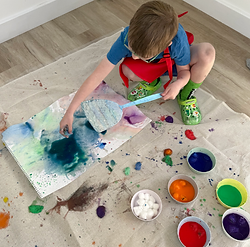

What is Art Therapy?
Art Therapy is an established form of Psychotherapy delivered by trained Art Therapists (also known as Art Psychotherapists).
We use creative approaches alongside the therapeutic relationship to support emotional wellbeing, reduce distress and promote greater self-understanding. You do not need to be good at art to benefit from Art Therapy.
Some people come to Art Therapy wanting to talk, while others find that thoughts and feelings emerge more easily through creative exploration. There is no right or wrong way to work. Sessions may involve conversation, drawing, painting, working with clay, exploring symbols and images, or simply engaging with materials in a tactile way. These approaches can help us access experiences, emotions, and insights that feel difficult to put into words. You are supported to use the approach that works for you.
The emphasis is not on the art, but on the meaning that emerges through the process. Together, we pay attention to what arises, reflect on it, and explore how it connects to your life and experiences. Each session is shaped around your needs, interests, and way of working.
Art Therapy can support people of all ages and at every stage of life. It may be helpful for those experiencing anxiety, low mood, trauma, bereavement, relationship difficulties, life transitions, challenges with emotional regulation, menopause, end-of-life, a diagnosis of illness, or the lasting impact of difficult life experiences. Through the creative process, art therapy provides a safe and supportive space to explore feelings, gain insight, and find new ways forward.
Art Therapy is not new. It's been around for a long time and is underpinned by significant research. It's widely used within NHS and other services. Art Therapist/Psychotherapist is a protected title and, in the UK, it is illegal to use the title unless you are registered with the HCPC (Health and Care Professional Council), which requires completion of approved Masters degree training and adherence to codes of practice and ethics.


Get in touch
Feel free to reach out with any inquiries or to book an initial consultation.
Complete and submit the form or call 07871 367522

Phone: 07871 367522

Fully insured - Professional Indemnity and Public Liability
Level 3 safeguarding and CAMHS Safeguarding Children Specialist Training
© 2026 Cheshire Therapy Space
Frequently asked questions
Do I need to be good at art?
No. Art psychotherapy is not about artistic ability or creating beautiful artwork. The focus is on expression, reflection, and understanding rather than the finished product. Many adults who come to art therapy haven't made art since childhood, while others prefer not to make art at all. There is no right or wrong way to engage in the process.
Do all sessions involve making art?
No. Some sessions involve art-making, while others are primarily conversational. Therapy is tailored to the individual, and together we can find an approach that feels comfortable and helpful for you.
What happens during the initial consultation?
The initial consultation is offered free of charge and provides an opportunity for us to meet, talk about what has brought you to therapy, and consider whether art psychotherapy may be helpful. Therapy is a collaborative process, so it is important not only that I feel able to support you, but also that you feel comfortable working with me. The consultation gives us both a chance to get to know one another, think together about your needs, and discuss any questions you may have about the therapeutic process. There is no obligation to continue after the consultation. If we both feel that art psychotherapy is the right fit, we can agree together on a plan for ongoing sessions.
What happens in an art therapy session?
Every session is different. Some people choose to use art materials, clay, or other creative approaches, while others prefer to talk. Together, we find an approach that feels comfortable and helpful for you. There is no expectation to make art in a particular way or to work towards a specific outcome. The focus is on exploring your experiences at a pace that feels right for you.
How long is a session and how many will I need?
Sessions usually last for one hour. Everyone's needs are different, but therapy is usually planned in blocks of six sessions, which are reviewed regularly and adapted according to your needs. Some people attend for a short period around a specific difficulty, while others benefit from longer-term therapeutic work. We will discuss this at the initial consultation and we will revisit this conversation throughout the therapy process.
How much does it cost?
Individual art psychotherapy sessions usually last one hour and are charged at £60 per session. An initial consultation is offered free of charge to help us decide whether working together feels like the right fit. I offer a reduced fee for trainee art psychotherapists who are enrolled on a recognised Master's Art Psychotherapy course and are seeking longer-term personal therapy as part of their professional training.
How is Art Psychotherapy different from counselling, talking therapy or CBT?
Art psychotherapy is a form of psychotherapy that can include talking, but it also offers other ways of exploring thoughts, feelings, and experiences when words are difficult to find. Some therapies, such as CBT, are often more structured and goal-focused, helping people identify patterns of thinking and develop practical strategies for change. These approaches can be highly effective for many people. Art psychotherapy takes a different approach. Rather than focusing primarily on solving a problem, it provides a reflective space to explore experiences, emotions, relationships, and patterns that may be outside of conscious awareness. Through talking, image-making, sensory materials, symbolism, play, movement, or creative exploration, we can begin to make sense of experiences that may be difficult to put into words. One of the unique aspects of art psychotherapy is that creative work can provide a visible record of the therapeutic journey. Looking back at artwork made over time can help people recognise changes, gain new insights, and reflect on experiences from a different perspective.
Can parents stay during their child's session?
This depends on the child's age, needs, and the purpose of the therapy. Sometimes it is helpful for parents or carers to be involved, while at other times children benefit from having a space of their own. This is something we can discuss during the initial consultation and review throughout the therapeutic process if needed.
Is everything confidential?
Confidentiality is an important part of therapy, and what you share will be treated with respect and care. There are some circumstances where confidentiality may need to be broken, such as concerns about your safety or the safety of another person, or where there is a legal obligation to share information. Wherever possible, this would be discussed with you first. As a HCPC-registered Art Psychotherapist, I am also required to attend regular clinical supervision. Clinical supervision is an important professional and ethical safeguard that helps ensure safe, effective, and reflective practice. During supervision, aspects of client work may be discussed with my clinical supervisor, who is also a qualified and registered healthcare professional and is bound by the same standards of confidentiality. Information discussed in supervision is treated confidentially and is not shared outside of this professional setting.
Will I keep the artwork?
Artwork created during therapy is stored securely between sessions. Throughout the therapeutic process, we may revisit artwork at review points, using it as a way of reflecting on thoughts, feelings, themes, and changes over time. One of the unique aspects of art psychotherapy is that artwork can provide a visual record of your therapeutic journey. Looking back at images, objects, or creative work created at different stages of therapy can often bring new insights and help you recognise changes that may otherwise be difficult to see. At the end of therapy, you will usually be offered the opportunity to take your artwork with you.
Where is Cheshire Therapy Space?
Cheshire Therapy Space is located on Hoole Road in Chester, within easy reach of Chester railway station and local bus routes. As the therapy space is situated at my home address, the full address is not published on the website. This helps to maintain privacy and confidentiality for both clients and my family. The full address, directions, and any relevant access information will be provided when you make an enquiry or arrange an initial consultation.
Is the therapy space accessible?
Yes. The therapy space is located at ground level and access is via a slight ramp, and a wide entrance door with a low threshold to support ease of access for wheelchair users and those with mobility difficulties. There is a toilet on site. While it is not classified as a fully accessible toilet and does not meet all accessibility standards, it has a wide outward-opening door designed to maximise available space and improve ease of access. It's a big space with no fixed furniture, so things can easily be mooved around to suit accessability requirements. If you have any specific access requirements, please feel free to get in touch before your appointment. I will be happy to discuss your needs and answer any questions about the space.
Is parking available?
Yes. Free on-road parking is available directly outside the property. The therapy space is situated on a quiet residential street where parking is generally plentiful, and clients can normally park directly outside the property or within a few metres of the entrance. There are no parking charges, permits, or time restrictions to worry about.
Can I get to Cheshire Therapy Space by public transport?
Yes. Cheshire Therapy Space is conveniently located on Hoole Road in Chester and is easily accessible by public transport. Chester Railway Station is approximately a 20-minute walk away, and there is a bus stop directly outside the property, with regular local bus services connecting the area to Chester city centre and surrounding neighbourhoods. If you are travelling from further afield and would like advice about the easiest route, please feel free to get in touch.
What kinds of difficulties can Art Psychotherapy help with?
People seek support for many different reasons, including anxiety, low mood, trauma, bereavement, relationship difficulties, life transitions, emotional regulation difficulties, school-related challenges, pregnancy and early parenthood, neurodiversity, and experiences that feel difficult to put into words. You do not need to have a diagnosis to access therapy.
Is Art Psychotherapy used in the NHS?
Yes. Art psychotherapists work across a range of NHS services, including child and adolescent mental health services (CAMHS), adult mental health services, community teams, hospitals, specialist services, and inpatient settings.
What qualifications does an Art Psychotherapist have?
In the UK, Art Psychotherapist is a protected professional title. Art psychotherapists complete a Master's-level professional training and must be registered with the Health and Care Professions Council (HCPC) in order to practise using this title. I am a HCPC-registered Art Psychotherapist and a member of the British Association of Art Therapists (BAAT).
What is dyadic parent/carer-child therapy?
Dyadic parent/carer-child therapy is a specialised form of art psychotherapy that focuses on the relationship between a child and their parent or caregiver. Rather than working solely with the child, the therapy supports the relationship itself, recognising that children develop and thrive within their important attachment relationships. In this way, the therapist becomes the therapist for the relationship, rather than the therapist for either individual. Dyadic therapy can be helpful where there are difficulties in the parent-child relationship, emotional or behavioural challenges, attachment difficulties, family transitions, trauma, anxiety, or Emotionally Based School Avoidance (EBSA). It can also be beneficial when parents feel stuck, concerned about their child's wellbeing, or unsure how best to support them. Sessions usually take place weekly and often alternate between parent-and-child sessions and parent-only sessions. This creates space to understand the child's experiences, reflect on relationship patterns, strengthen communication, and explore new ways of responding to difficulties together. Creative activities and art-making can provide a safe and accessible way for both parent and child to express thoughts and feelings that may be difficult to communicate verbally. Through the process, families can develop greater understanding, connection, and emotional attunement.
What is perinatal art psychotherapy?
Perinatal art psychotherapy is a specialised area of art psychotherapy that supports emotional wellbeing during pregnancy and early parenthood. The perinatal period is generally understood to span from conception until a child reaches two years of age. This period can bring significant emotional, psychological, and physical changes. While it can be a time of joy and anticipation, it can also be accompanied by anxiety, uncertainty, loss, trauma, identity changes, or mental health difficulties. Perinatal art psychotherapy provides a safe and supportive space to explore these experiences. A key focus of perinatal work is the developing relationship between parent and child. Early relationships provide the foundation for a child's emotional development, and supporting parents during the perinatal period can have lasting benefits for the whole family. Perinatal art psychotherapy can help strengthen attachment, support emotional wellbeing, and create space to reflect on the experience of becoming a parent. Perinatal art psychotherapy may be helpful for those experiencing: Anxiety during pregnancy or after birth Low mood or postnatal depression Difficulties adjusting to parenthood Fear of childbirth (tokophobia) Birth trauma or previous traumatic birth experiences Pregnancy complications Miscarriage, stillbirth, neonatal loss, or termination of pregnancy Fertility difficulties and assisted conception journeys Existing mental health difficulties during pregnancy or early parenthood Challenges in bonding with a baby or developing confidence in the parenting role Art psychotherapy offers opportunities to explore experiences through both talking and creative expression. This can be particularly valuable when emotions feel overwhelming, complex, or difficult to put into words.